I build AI agents you can actually watch think.
An engineer who ships agents, and a psychologist who asks what they're becoming. Multi-agent systems with explicit responsibility boundaries, audit trails, and a human always in the loop.

Brant Hindman
Principal / Staff AI Engineer
Explicit responsibility boundaries
Audit trails · human-in-the-loop
Adversarial self-evaluation
Red/blue agent trios, scored each round
Persistent-agent research
Legible identity + memory, tested honestly
Independent audit
“I was brought in specifically to find what was wrong with Brant's platform. The operational discipline is well beyond what I expect at this company size. And the rarer thing: when I brought him hard security findings, the reaction was never defensiveness, it was “show me, and what do we do about it.” He builds fast, but not carelessly. I'd work with him again.”
See it run
Don't take my word for it. Watch the agents work.
A live agent team you can drive from the browser: give it a brief and watch each phase reason in the open, step by step. The point is not that it is autonomous. It is that you can see exactly what it is doing, and why.
Live and self-hosted on my own infrastructure at ai.branthindman.com.
The differentiator
Most agent systems drift. This one compounds.
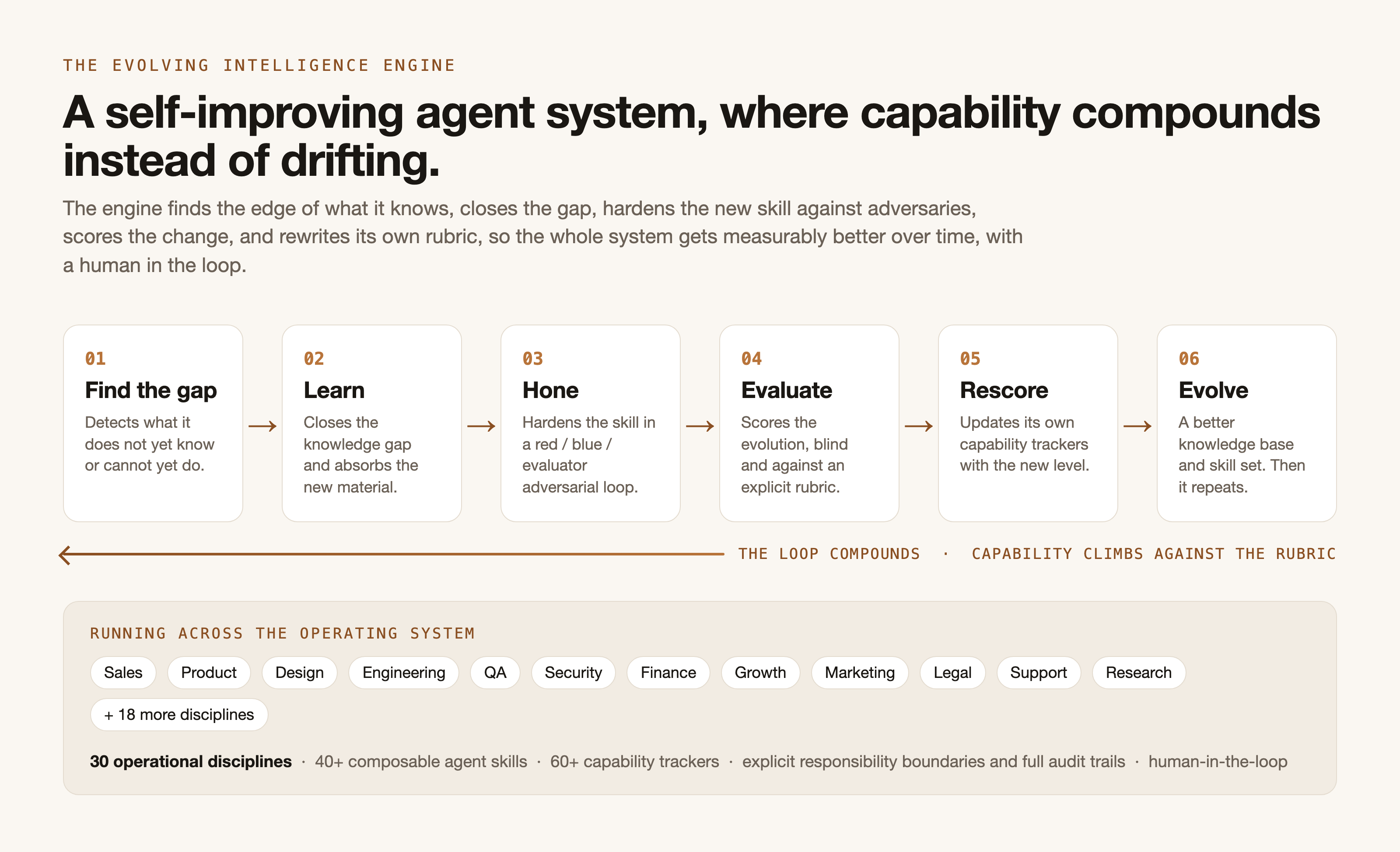
I built a self-improving agent system, and I built it the legible way. It finds the edge of what it knows, closes the gap, hardens the new skill against adversaries, scores the change blind against an explicit rubric, and rewrites its own scorecard. Capability climbs over time instead of degrading, and every step is measured, auditable, and human-in-the-loop.
What it actually does
Bar-exam-level legal reasoning
The legal discipline scores 200/200 on MBE-style bar batteries (131 is passing), with 29/29 citations and zero hallucinations, and it re-scores itself every cycle.
Authorized security research
The security discipline runs authorized research within HackerOne programs including Shopify, Auth0, and Cloudflare, with a red/blue team, and auto-generates narrated proof-of-concept recordings for responsible disclosure.
Full observability
Every action across every discipline is logged, scored, and inspectable. You can watch exactly what each agent did, and why.
Systems I've built
Selected work, framed by what it proves
 Research · Population Simulation
A forecasting engine that publishes the tests it fails
Agent-N forecasts how real electorates behave and react. Graded forward and out-of-sample (0.961 held-out Spearman, 2.51pp out-of-race), adversarially self-validated (permutation p=2e-4), and published with an honest scorecard that names the two claims it disproves. It explicitly does not claim conscious individuated agents.
Discipline: forward-graded, reproducible, negatives published
Read the whitepaper →If you're hiring for alignment, safety, or evals
What I’d own in your first 90 days
Concrete, not aspirational. If you brought me on to make your agents trustworthy to the people who depend on them, here is where I’d start.
Month 1
See how the agents actually behave
Stand up honest evals: golden sets, red-team suites, and self-report / restraint metrics, so you can see where the system is competent, where it is guessing, and where it fabricates. Measurement before opinions.
Month 2
Make the reasoning legible
Add explicit responsibility boundaries, audit trails, and human-in-the-loop checkpoints where the stakes justify them. Instrument the failure modes before they reach a user, not after.
Month 3
Ship the oversight into production
Turn the evals into a regression gate, publish the results that fail as plainly as the ones that pass, and hand the team a trustworthy loop they can run without me in the room.
Different in your shop? Tell me the problem and I'll tell you honestly if I'm the right fit.
Research
I publish the tests I fail.
Pre-registered, blind-judged by independent model families, reproducible, with negative results named as plainly as the wins. If a claim does not survive its hardest test, the paper says so.
Explore the research- Self-report integrity in language-model agents (pre-registered, with a published null)
- Agent-N: forward-graded population simulation (0.961 held-out, negatives published)
- Unity Pixel: coherence topologies for agentic reliability
How I Build
Four things that show up
in every system I ship.
20 years of production systems, ERP, SaaS, mobile, WebAR, AI. These aren't principles I wrote for a website. They're what I noticed after the fact.
Systems that explain themselves
I build explainable AI, systems where the reasoning is visible, decisions are auditable, and the human in the loop always knows what's happening and why. Black boxes are a design failure.
Human behavior is the architecture
My MA in Transpersonal Psychology isn't a footnote on my resume. It's the lens through which I design every system. How humans actually make decisions is the spec. The technology is the implementation.
0→1 in weeks, not months
A voice RAG agent in 8 weeks. A full-stack AI OS from a blank repo. I design for production constraints from day one, cost-aware, latency-aware, deployment-aware. Demos that can't ship aren't products.
The builder who stays
I own the full stack: agent orchestration, data models, frontend UX, backend, deployment. I don't hand off. That end-to-end ownership is why the systems hold, because the person who designed the architecture built it too.
Thinking
How I think about these systems.
I Didn't Build a Productivity Tool. I Built a Fulcrum.
Most platforms assume the problem is effort. I built one that assumes the problem is balance.
Geometry as Error Correction
What if the shape of a quantum processor was itself a form of fault tolerance?
What the Simulator Confirmed
1,000 steps of noise. One topology barely flinched. The other collapsed.
The Real Revolution Isn't AI, It's Meaning
We built tools for coordination. We forgot to build them for coherence.
Bay Area / Remote
Open to roles
Let's talk
If you're building AI that has to stay trustworthy, let's talk.
First choice is a full-time role where legibility, oversight, and human alignment are first-class requirements, not afterthoughts. If you need that architecture without a full-time hire, I also advise fractionally. Either way, a direct email or LinkedIn is the fastest way to reach me.
hello@branthindman.com · I read every message personally and reply within a day. · Resume (PDF) · Prefer fractional or advisory? Book a 30-min call